Power of Trace
This work began with a photograph I came across by chance. Lyman, a fiercely contested city between Ukraine and Russia: above it, transparent lines covered the rooftops like a spider’s web. They were optical fibers left behind by drones. But this work is not about that war. What I saw in that image was a distance, and an overlap.
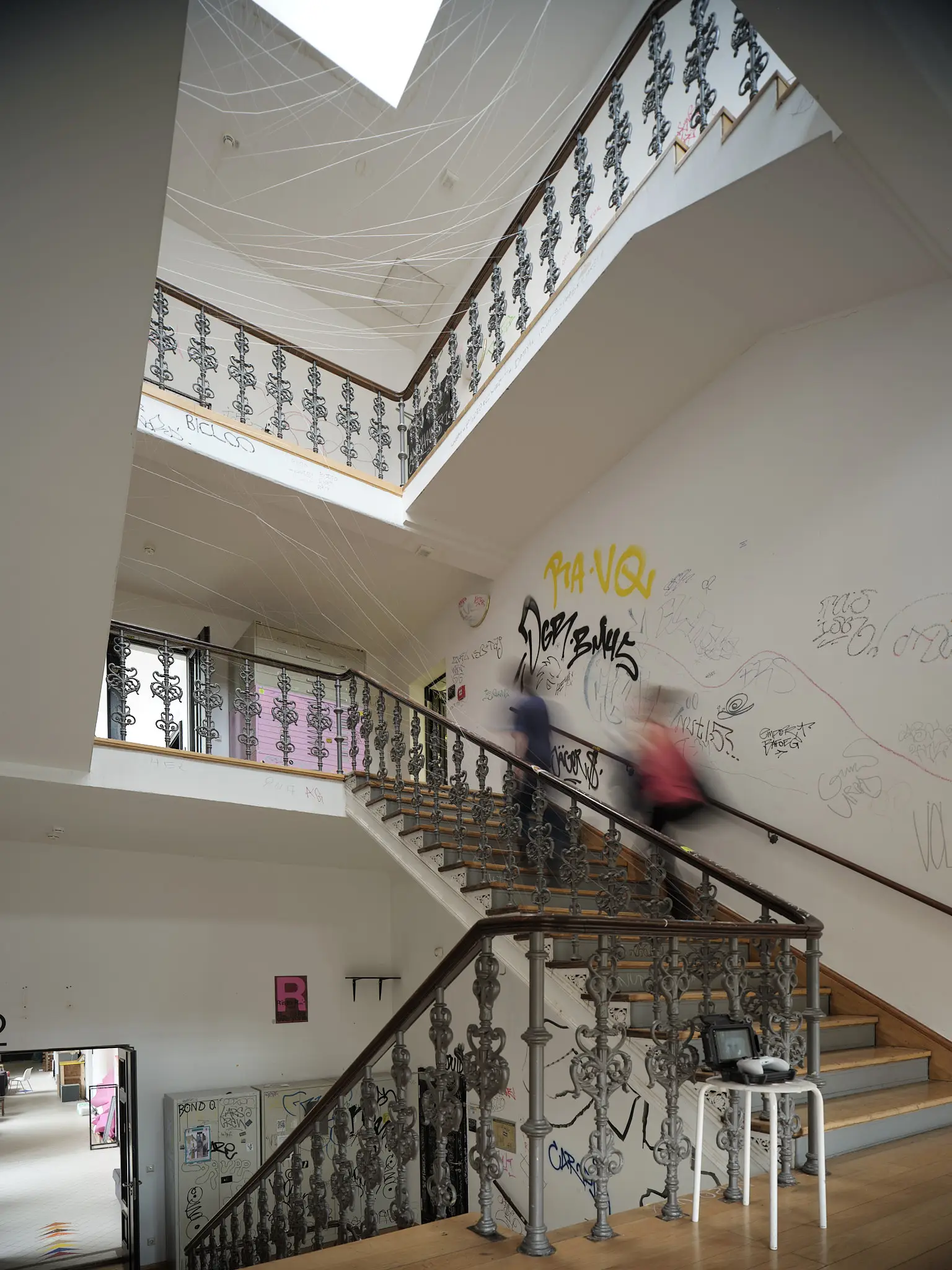
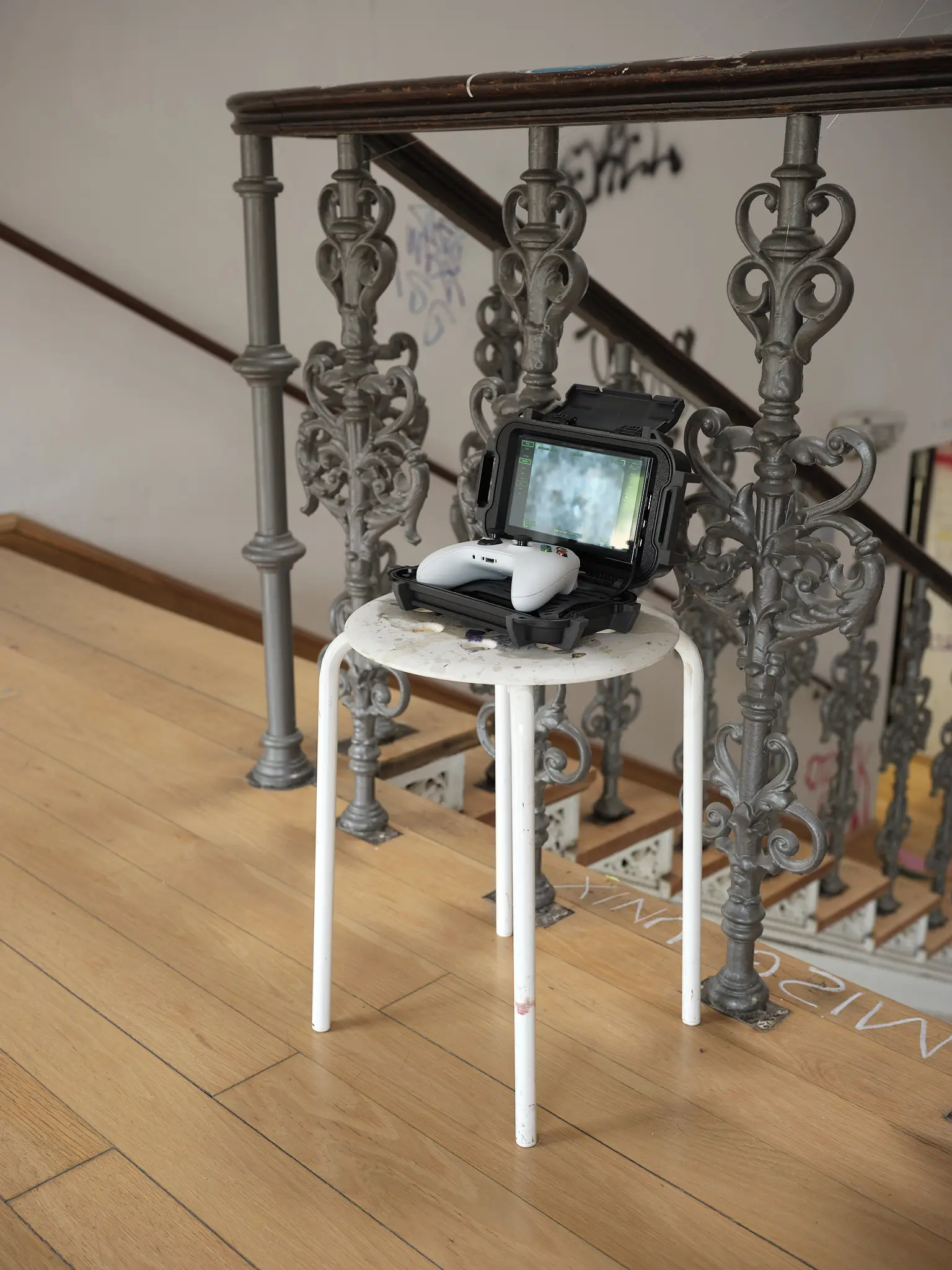
I wanted to install this work in an everyday space. Not in a gallery or a closed room surrounded by white walls, but in a school corridor that everyone passes through freely. Schools are among the first places to be requisitioned when war begins. A classroom where lessons have stopped becomes a command post. The chair we once sat on to draw becomes a mount for military equipment.
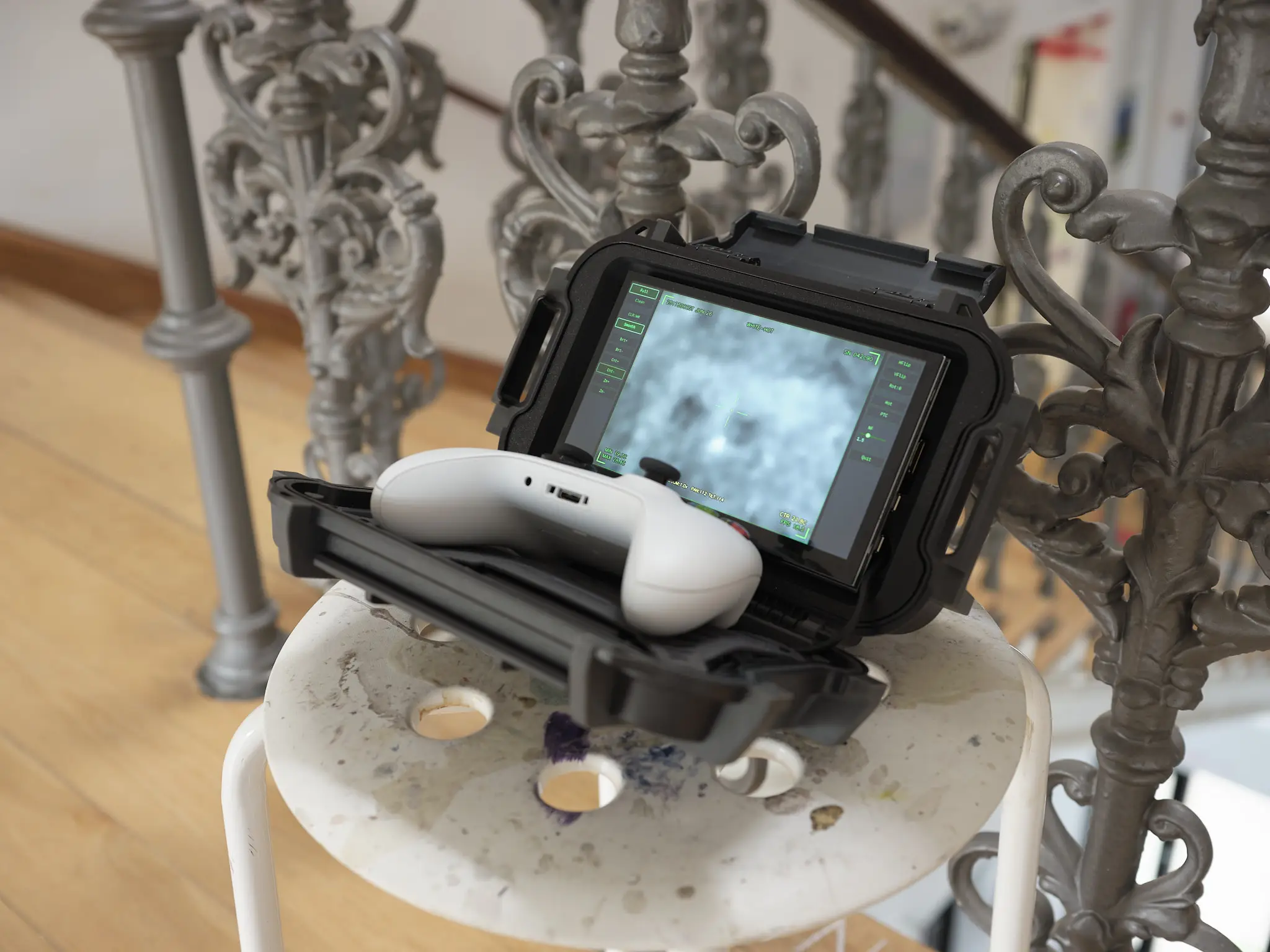
On that chair sits a portable monitor I built myself in a military style. The thermal camera connected to it transmits only low-resolution, pixelated images. The human figure on the screen has no face, no outline. It is reduced to crudely smeared pixels, a single mass. When you stand in front of the screen, the first pixel mass it captures is you. The one who sees becomes the one who is seen, and you experience firsthand how a person is reduced to pixels. The camera’s gaze is steered with this game controller. The controller was designed to give its user the most intuitive and comfortable experience possible. Thanks to this design, soldiers can operate military equipment with little or no training. The interface of play has become the interface of war.
From time to time, you can also hear drones passing by. This sound is not a real recording. I wrote a program that emulates drone sounds, and through it the drone noise is generated in real time. These drones are not targeting this place. They simply pass overhead. We are not standing on a battlefield, but somewhere in between.
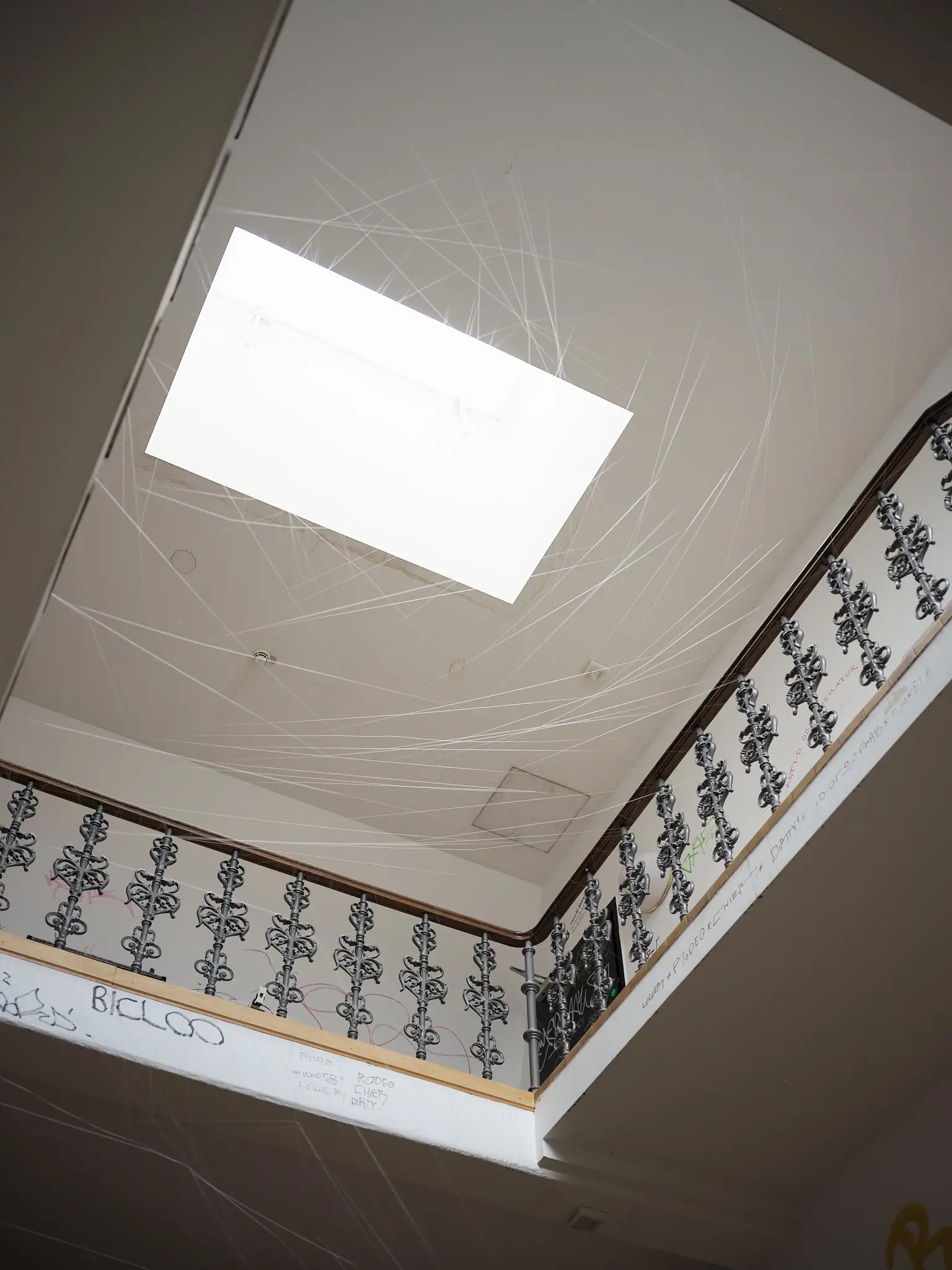
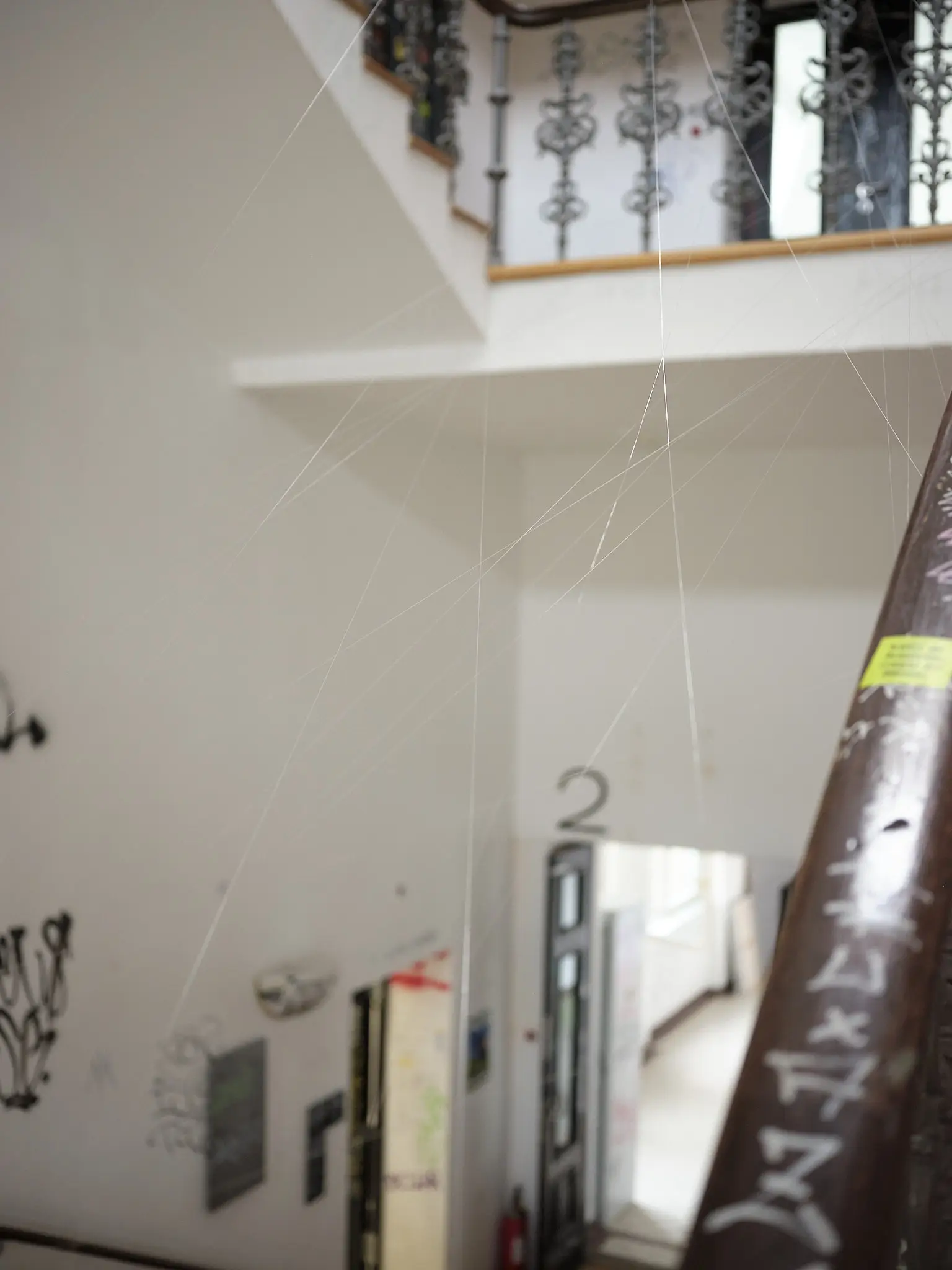
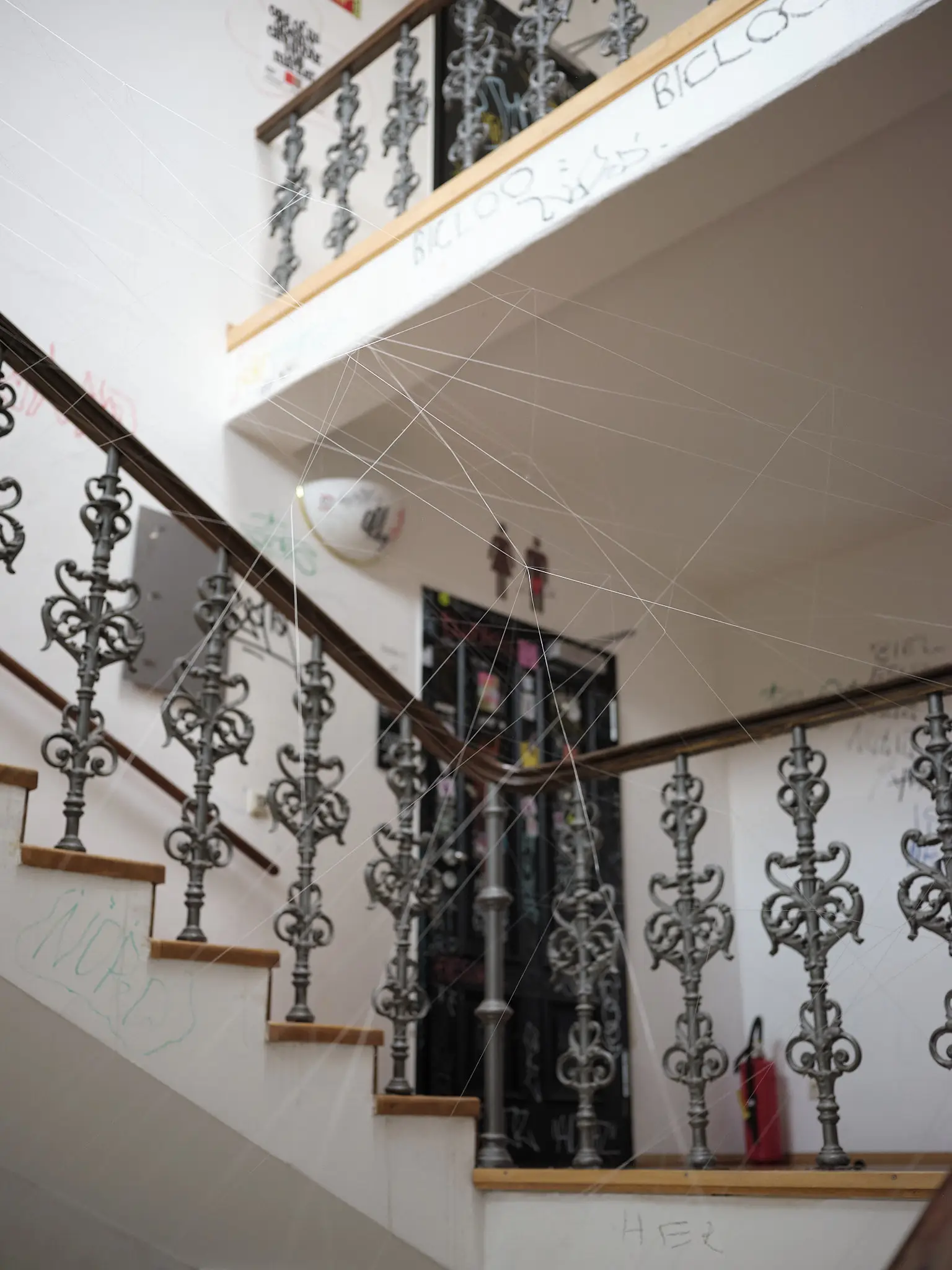
Where a drone passes, it leaves a trace. The lines over Lyman were exactly that. To express this trace, I wove nylon thread irregularly across the stair railing in place of military optical fiber. I wanted to use the fiber actually used in drones, but I couldn’t buy it. Probably because the entire production is being delivered to the military…
In fact, this optical fiber is very close to our everyday lives. Optical fiber transmits data at the speed of light and is a core element of modern networks. Most of the world’s internet traffic travels through fiber-optic cables. Yet we never get to see them. Most are wrapped in thick sheathing and buried underground, under the sea, inside walls. In the Russia–Ukraine war, fiber-optic drones were developed to evade radio jamming. Tens of kilometers lie between the pilot and the drone. In between, lines thinner than a hair are left behind. And that distance keeps growing.
The remoteness of war is not only physical. It unfolds on several levels. One is moral distance. The target on the other side of the screen becomes data, and the distance between the hand that pulls the trigger and death keeps growing. The age of crossing blades, of shooting at a distance where you could see the other’s face, is over. As the distance grows, the sense of moral responsibility fades. Another is social distance. Until around the First World War, going to the front was an honor, and sons of the privileged classes often rushed to volunteer. The battlefield belonged to heroes. But after the Cold War, most Western countries switched to volunteer armies, and those who fill the ranks are mostly people with few other options. Standing closer to war on behalf of the rest of the citizens, they receive those citizens’ taxes in return. Those who go to the front, and the rest who watch from afar. Under the same sky, the two live in different worlds.
Once, the camera was held in a human hand. That hand, entering the battlefield at the risk of its life, carried the face of war out to the rest of the world. Today, however, the camera no longer needs a human hand. It is mounted on drones, on missiles, on turrets. It no longer holds people, only data. The pilot looks at the data on the screen and moves the controller. Move, confirm, next. Move, confirm, next. The device that once tore down the wall between two worlds now pushes them further apart.
At the same time, war and everyday life overlap. A drone pilot eats breakfast at home, drives to the base, eliminates a target on the screen, then drives home for dinner with his family. His spouse asks, “How was your day?” On the other side, even on a day when a missile has struck the building next door, people sweep up the broken glass, buy breakfast beside the collapsed shop, and send their children to school. No matter how great the distance, at some point, an overlap occurs.
We all know war. We see it on the news, on YouTube, on TikTok. But knowing is not the same as feeling. Knowing is our greatest illusion. When I fired a gun for the first time in basic training, the recoil, the sound, and the vibration made me realize that what I thought I “knew” was an illusion, and an arrogance. Before the pitch-black sea at the observation post, before the thermal monitor under the air conditioner, at the trigger of a heavy machine gun spitting out hundreds of rounds larger than my finger, I may have been under the same illusion.
Images show us a great deal. But precisely because of that, they push the viewer into the position of an observer. Feeling compassion from an image also becomes an alibi, confirming that I am not involved. As this repeats, it becomes something that has nothing to do with me, and we grow numb. And yet we still believe that we “know.”
I have not reproduced war here. I only hope that you can feel it, even a little. Sound is more powerful than images. We cannot see it. We cannot know it. We can only feel it.